
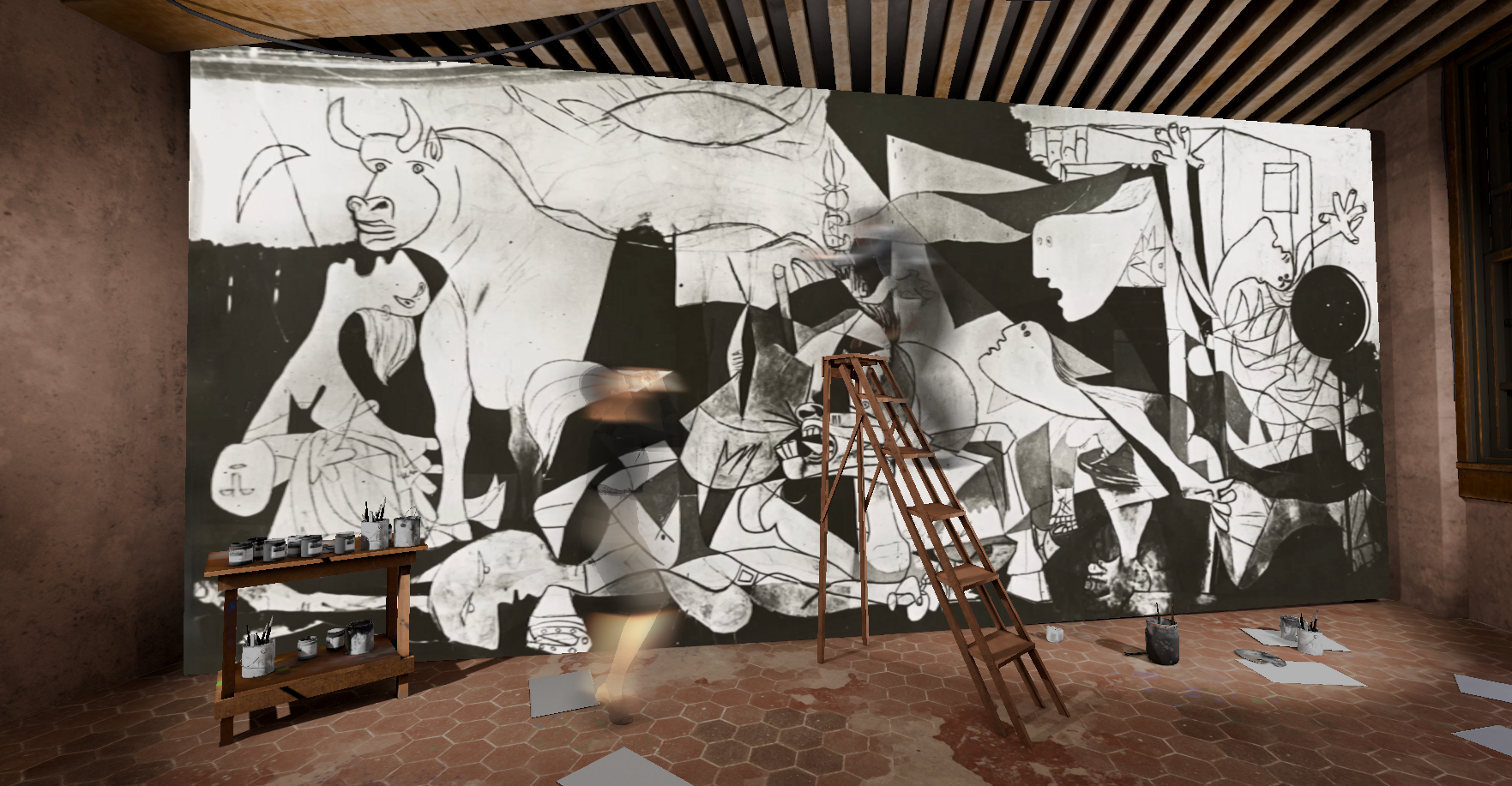


Guernica, an iconic work in the history of art, is a political symbol that artists and citizens have adopted to denounce contemporary conflicts and the oppression of minorities. In doing so, they all seem to be echoing the words Picasso spoke in 1945:
"No, paint is not meant to decorate flats: it is an offensive and defensive weapon against the enemy"
Late 1936 – early 1937: Whilst Paris was preparing for the International Exhibition of Arts and Technology, the Spanish Republic, embroiled in a civil war, established its national pavilion as a symbol of resistance against General Franco’s coup d’état. Max Aub and Juan Larrea, cultural attachés at the Spanish Embassy in Paris, commission Pablo Picasso to create a large painting for the pavilion designed by the architects Josep Lluís Sert and Luis Lacasa.
April 1937: Far from depicting the war, Picasso’s initial sketches revolve around the classical theme of the painter and his model.
26 April 1937: The small Basque town of Gernika is attacked by aircraft from the Nazi German army and the Italian fascist regime, allies of Franco’s forces. Causing hundreds of deaths, it is the first mass civilian bombing in history and a testing ground for Hitler as he prepares for total war.
28 April 1937: In Paris, photographs and eyewitness accounts of the bombing are published in the press. His partner, Dora Maar, a surrealist photographer and anti-fascist activist, along with his friend the poet Paul Eluard, encourage Picasso to publicly champion a political cause by seizing upon this historic tragedy.
1 May 1937: Picasso produced an initial sketch, followed by 41 others, choosing to depict victims of the bombing. Maar, commissioned by Christian Zervos to photograph the process for Cahiers d’art, documents the evolution of the composition and the experiments with coloured wallpaper, which were ultimately abandoned in favour of black and white, more in keeping with the gravity of the subject and better suited to the work’s media dissemination.
24 May 1937: The International Exhibition of Arts and Technology opens. The global political climate is extremely tense, as reflected in the aggressive confrontation between the eagle and the Soviet couple depicted on the imposing pavilions of Germany and the USSR.
4–5 June 1937: Picasso completes his large painting Guernica.
12 July 1937: The Spanish Republican Pavilion is inaugurated: curator José Gaos presents works by predominantly Spanish artists denouncing Franco’s massacres. Paintings and sculptures by Joan Miró, Julio González and Alexander Calder stand alongside the large canvas Guernica, as well as Picasso’s cement sculpture, La femme au vase.
January–April 1938: Guernica was then exhibited in Norway, Denmark and Sweden alongside works by modern artists.
October 1938 – September 1939: Guernica embarked on a long journey around the world to raise funds in support of the Spanish Republicans: first to England, then to the United States, visiting New York, Los Angeles, San Francisco and Chicago.
1939–1953: Whilst the Museum of Modern Art in New York (MoMA) was organising a retrospective of Picasso’s work with several stops (St Louis, Boston, Cincinnati, Cleveland…), the outbreak of the Second World War forced the artist to keep several works, including Guernica and its sketches, in the United States.
1953–1956: In the aftermath of the war, Picasso joined the French Communist Party, publicly committing himself to the cause of peace. Guernica gradually became a symbol of the fight against barbarism. The painting featured in several major retrospectives dedicated to the artist in Milan, São Paulo, Paris, Munich, Cologne, Hamburg, Brussels and Stockholm.
1957: Guernica takes part in a new touring exhibition in the United States (New York, Chicago, Philadelphia), before returning to the galleries of MoMA.
1969: Picasso states in the newspaper Le Monde that Guernica will only return to Spain once “democratic freedoms have been restored”.
8 April 1973: Picasso dies at his home in Mougins, in the south of France.
1975: Franco dies on 20 November.
1977: In Spain, the first free elections since 1936 are held and a new constitution is approved the following year.
9 September 1981: Guernica is finally returned to Spain in accordance with the artist’s wishes. The painting is exhibited at the Casón del Buen Retiro (now the Prado Museum) in Madrid.
June 1992: Guernica is permanently transferred to the Museo Nacional Centro de Arte Reina Sofía in Madrid.