



Welcome to this exhibition of Henry Taylor’s work!
Henry Taylor was born in 1958 in a small town in California, USA. He worked in a mental hospital for ten years before starting his career as an artist at the age of 38. His paintings and sculptures portray the history and lives of the people around him. Now based in Los Angeles, Henry Taylor is one of America’s most famous artists.
Look for this symbol to guide you around the exhibition!

2. Untitled, 2019
Do you know what the three images in this work have in common? They represent important moments in Black history. On the left, you see Toussaint Louverture, a hero of the Haitian Revolution who fought against slavery and colonisation. In the centre, repeated painted words remind us of the importance of remembering revolutions. On the right, the artist draws inspiration from a photograph showing the funeral of Carol Robertson, a fourteen-year-old girl killed in a racist bombing in 1963 in the USA.
Room -1.1: Beginning
3. Screaming Head, 1990
A hunched-up man sits holding his head in his hands. In this vibrant painting, the head forms a big, open mouth. Henry Taylor worked nights for many years as a psychiatric technician in a mental hospital and this portrait may be a memory of one of his former patients. Do you think this mouth is laughing or screaming?
Room -1.2: Everyday Resonance
4. Cora (Cornbread), 2008
In this painting, Henry Taylor shows us an old stove on which his mother used to cook meals for her eight children. There’s a cake that looks as if it has just come out of the oven. It’s cornbread, a word that Taylor has written in brushstrokes at the top of his composition. Can you see the four letters he has circled? Cora is his mother’s name. What about you? Is there a dish that reminds you of someone you love very much?
Room -1.3:
5. It's like a jungle, 2011
At first glance, we mainly recognise everyday objects – chairs, cans, stacked cardboard boxes. By assembling them in this way, Henry Taylor has created a large installation that makes us think of a crowd with raised fists. Do you think Taylor wants to pay tribute to those who fought for equal rights between Black and White people? What does this installation make you think of?
Room -1.4: Normal People
6. Haitian working (washing my window) not begging, 2015
What is this young man with downcast eyes doing? The title may give you a clue: this man from Haiti is cleaning the windscreen of the artist's car. You can also identify the rear-view mirror in the top right corner of the painting. It is as if Henry Taylor is inviting us to observe the scene with him, from his car, and to pause and consider these street workers who we tend to ignore.
Room 0.1: Heroes
9.A Jack Move – Proved It, 2011
In the past, artists primarily painted portraits of mythological heroes or famous historical figures. Henry Taylor continues this tradition with this painting inspired by a famous photograph. It depicts Jackie Robinson, the first African-American player to join a major baseball team in 1946. Robinson used his celebrity to fight against racial discrimination.
Room 0.2: Faces of a Nation
10. The 4th, 2012
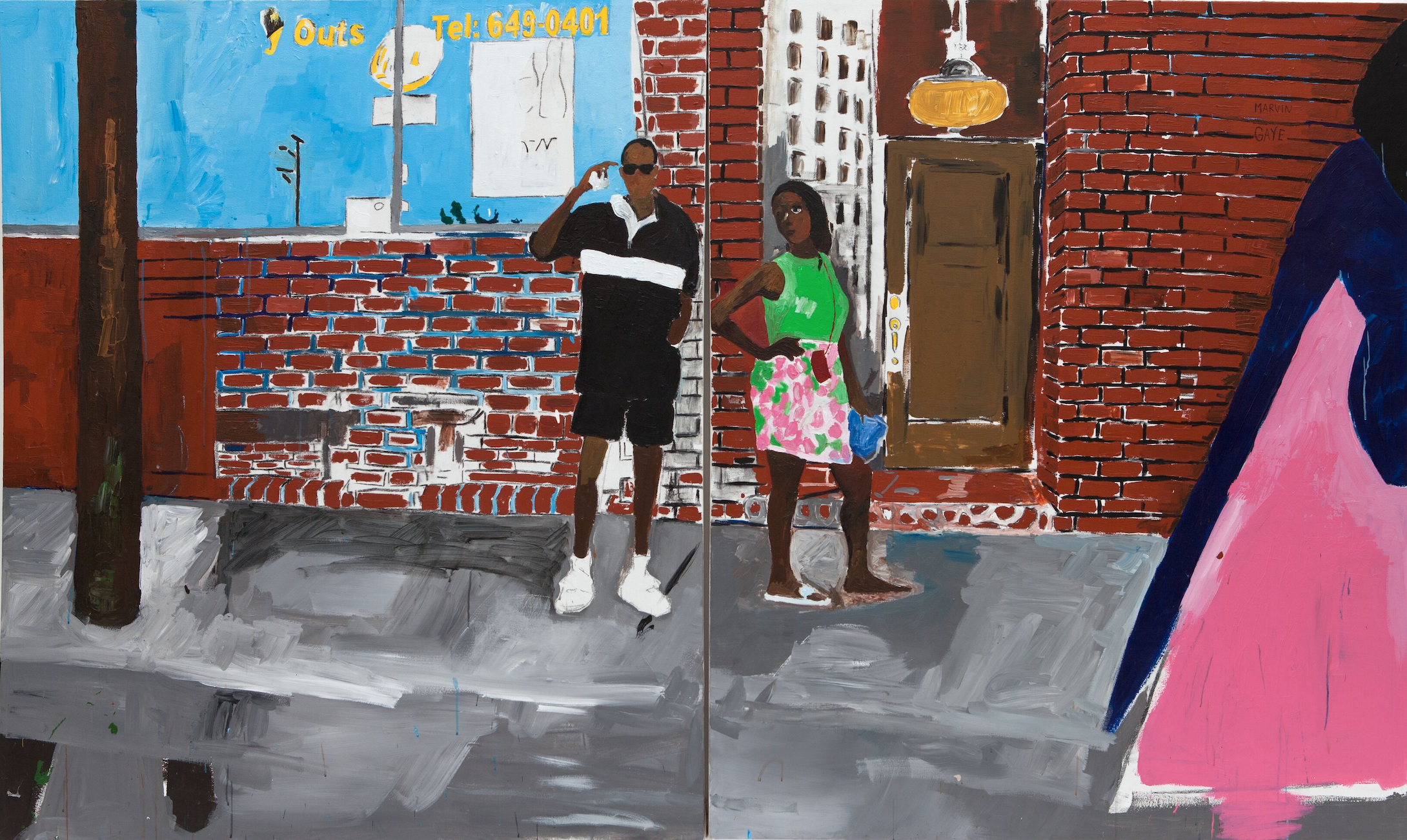
Henry Taylor has assembled two superimposed panels to create a monumental work over four metres high. The artist immerses us in a typical scene from everyday life in America: a character is busy preparing the traditional barbecue celebrating the 4th of July – the national holiday. Simple and majestic, a woman occupies the centre of the painting. But can you see the four walls in the background to this joyful scene? Could they be those of a prison?
Room 0.3: Faces of a nation
11. Mary had a little . . . (that ain't no lamb), 2013
Who is this woman in the centre of the painting? We don’t know her name, and we can’t see her face. But the laundry she’s just hung out and the calf behind her give us some clues about her daily life. Henry Taylor paints her with great care: her elegant dress is richly patterned. The artist doesn’t seek to make her invisible or ordinary; on the contrary, he shows her as strong and important. With this work, Henry Taylor makes the point that all people deserve our attention, regardless of their life or their history.
Room 0.4: Imagined Realism
12. Trail, 2005
Numbers, a sheriff's cap, raised hands . . . What a jumble this painting is! It's as if Henry Taylor had stuck together completely unrelated images. And yet they all have one thing in common: the story of George Jackson, an African American man arrested in 1960 for stealing a few dollars. In prison, he became a writer, speaking out against the brutality and racism suffered by African American prisoners. He was shot dead by guards in 1971. Bob Dylan, who can be seen in the top left corner of the painting, wrote a song in his honour.
Room 0.5: Painting (Picasso etc.)
13. From Congo to the Capitol, and black again (2007)
This painting echoes a famous work by Pablo Picasso, Les Demoiselles d'Avignon (1907). To paint the naked bodies and faces of these young women, the Spanish painter drew inspiration from African sculptures. So when the artist Henry Taylor visited Paris for the first time in 2007, he painted his own version of Les Demoiselles d'Avignon, in which Africa reclaims the painting by featuring dark-skinned characters.
14. Forest fever ain't nothing like, ‘Jungle Fever’ (2023)
Here, Henry Taylor reinterprets one of the most famous works in the history of painting, Édouard Manet's Le Déjeuner sur l'herbe. In the 1867 painting, two men in their Sunday best share a picnic in the forest with a naked woman. This painting caused a scandal! What do you think of Taylor's version? The artist sets the scene in the USA of today: young Black men, shirtless and wearing gold chains around their necks, have replaced the Parisian gentlemen in suits. Can you spot any other differences between the two paintings?
Room 0.6
15. THE TIMES THAY AINT A CHANGING, FAST ENOUGH! (2017)
The man lying in this car is Philando Castile: he was shot dead by a police officer during a routine traffic stop in Minnesota in 2016. The murder sparked protests across America. Henry Taylor uses a very limited number of colours to paint this event. He immerses us in this tragic scene by painting the victim in the foreground: the viewer becomes the first witness to this racist crime.